

Province Comparison: How Canadian Living Costs Really Stack Up
Choosing where to live in Canada significantly impacts your financial comfort, lifestyle, and long-term goals. This in-depth guide analyzes the cost of living across all ten provinces—focusing on housing, taxes, utilities, healthcare, childcare, education, and more. Whether you’re relocating for work, settling post-immigration, or simply evaluating budgets, you’ll leave informed and confident. With insight into each province’s unique financial profile, you’ll be able to match your priorities with the best location fit.

Why Provincial Comparison Matters
Canada’s provinces differ by up to 40–60% in living costs. For instance, a Toronto bachelor’s rent can match a family home in Regina. Understanding these variations helps you:
- Set a realistic moving budget
- Choose a work or study destination
- Make informed PR or job decisions
This page breaks down each province’s monthly and annual costs, then compares them in a summary for easy decision-making.
Key Comparison Categories
You’ll see metrics across eight indicators:
- Housing (rent and purchase)
- Utilities (electricity, heating, water, waste)
- Food & groceries
- Transportation (public transit, vehicle, insurance)
- Telecom & Internet
- Childcare & education
- Healthcare & insurance
- Provincial taxes & government benefits
Cost of Living in Canada – 2025 Overview
Understanding how much life in Canada truly costs is critical whether you’re relocating for work, education, or permanent residency. Expenses vary dramatically based on region, lifestyle, and family size, but several themes remain consistent:
- Housing is the largest monthly expense for most households, with downtown rents in Toronto and Vancouver among the highest in the country.
- Groceries have seen a 6–8% increase in 2024–2025 due to inflation and transportation costs.
- Transportation varies by transit system quality and car dependency—urban residents often save with public transit.
- Healthcare is largely public and free for citizens and PRs, but temporary residents and visitors must budget for private insurance.
Overall, expect a comfortable standard of living to cost CAD 2,800–4,500/month for a single adult in a mid-sized city and CAD 4,800–7,500 for a family of four in major metros.
How Canada Compares Globally
As of 2025, Canada ranks 22nd globally in overall cost of living, according to Numbeo’s Global Index, which uses New York City as the baseline (100). Canada’s composite score floats around 65.1, placing it slightly higher than:
- Germany (64.2)
- South Korea (61.7)
- Spain (56.9)
But still more affordable than:
- USA (71.1)
- Australia (72.3)
- UK (68.5)
Key Index Comparisons 2025:
| Country | Cost Index | Rent Index | Grocery Index |
|---|---|---|---|
| Canada | 65.1 | 38.4 | 72.7 |
| USA | 71.1 | 56.4 | 77.2 |
| Germany | 64.2 | 26.7 | 62.8 |
| South Korea | 61.7 | 22.5 | 63.3 |
| Australia | 72.3 | 45.6 | 78.4 |
This means day-to-day items like groceries, dining out, and transit are slightly cheaper in Canada than in the US or Australia, but housing affordability is still a pain point—especially in urban centres like Toronto, Vancouver, and Ottawa.
Cost of Living by Province & City
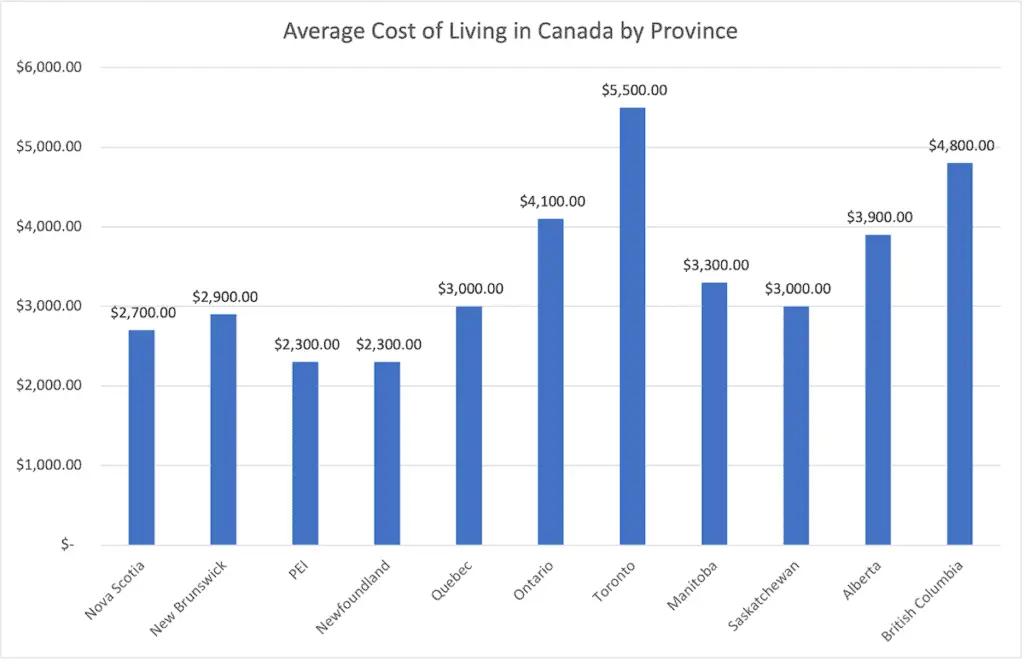
Canada’s cost of living isn’t uniform. Your experience will differ massively depending on where you live. Here’s how it breaks down:
High-Cost Provinces:
| Province | 1-Bedroom Rent | Transit | Avg Groceries (couple) | Childcare (per child) |
|---|---|---|---|---|
| Ontario (Toronto) | CAD 2,400–2,800 | CAD 156 | CAD 850–950 | CAD 1,500–2,200 |
| BC (Vancouver) | CAD 2,600–3,200 | CAD 102 | CAD 850–1,000 | CAD 1,600–2,400 |
| Quebec (Montreal) | CAD 1,400–1,800 | CAD 98 | CAD 700–800 | CAD 8–13/day (subsidized) |
Mid-Cost Provinces:
| Province | 1-Bedroom Rent | Transit | Avg Groceries (couple) | Childcare |
|---|---|---|---|---|
| Alberta (Calgary) | CAD 1,600–2,200 | CAD 112 | CAD 700–850 | CAD 1,200–1,800 |
| Nova Scotia (Halifax) | CAD 1,200–1,600 | CAD 82 | CAD 650–800 | CAD 1,000–1,500 |
| Manitoba (Winnipeg) | CAD 1,200–1,500 | CAD 102 | CAD 650–750 | CAD 900–1,200 |
Low-Cost Provinces:
| Province | 1-Bedroom Rent | Transit | Avg Groceries | Childcare |
|---|---|---|---|---|
| New Brunswick (Moncton) | CAD 900–1,300 | CAD 78 | CAD 600–700 | CAD 800–1,200 |
| Saskatchewan (Regina) | CAD 1,000–1,400 | CAD 88 | CAD 650–750 | CAD 850–1,200 |
| PEI (Charlottetown) | CAD 900–1,200 | CAD 72 | CAD 600–700 | CAD 800–1,100 |
Northern Territories:
Expect 20–30% higher grocery and transport costs due to remote access and supply issues. However, wages are often higher to offset these costs.
Cost of Living in each province
Annual Summary Comparison
| Province | Avg Monthly Cost (Couple) | Rank (1=cheapest) |
|---|---|---|
| New Brunswick | CAD 2,910–3,510 | 1 |
| PEI | CAD 2,860–3,560 | 1 |
| Saskatchewan | CAD 3,020–3,720 | 2 |
| Quebec | CAD 3,078–3,428 | 2 |
| Manitoba | CAD 3,320–3,890 | 3 |
| Newfoundland | CAD 3,085–3,985 | 3 |
| Nova Scotia | CAD 3,060–3,860 | 3 |
| Alberta | CAD 4,130–4,380 | 4 |
| Ontario | CAD 4,130–6,436 | 5 (varies, cities) |
| BC | CAD 5,335–5,935 | 6 |
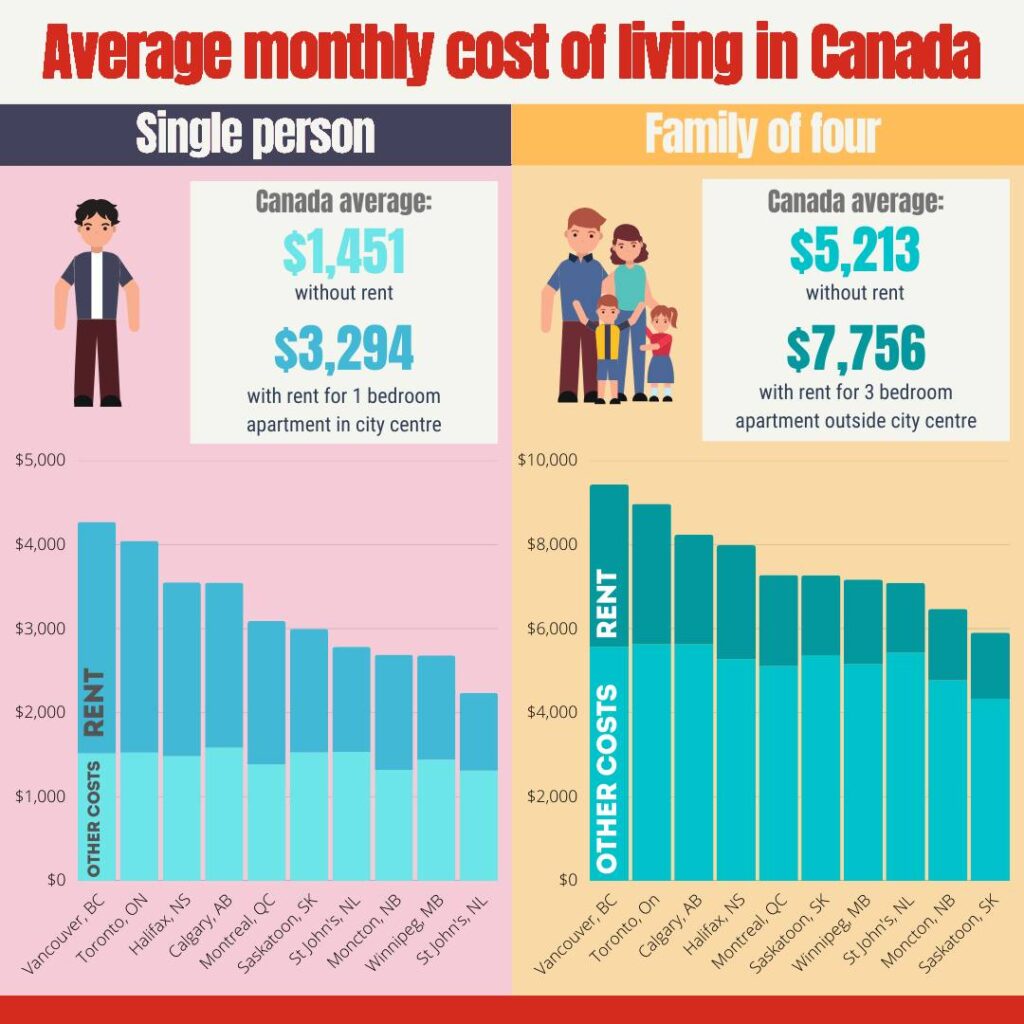
Budget BY LIFE STAGE
Single Adult
- PEI/NB: CAD 1,800–2,200
- Toronto: CAD 3,500–4,500
Young Couple
- Sask/Manitoba: CAD 2,800–3,200
- Vancouver: CAD 4,500–5,500
Family (2 adults + 2 kids)
- Quebec (~Montreal): CAD 4,500–5,500
- Toronto: CAD 5,500–7,500
Decision Factors Beyond Cost
- Job availability (Ontario, Alberta, BC lead)
- Language preference (English, French, Indigenous)
- Climate tolerance (PEI harsh winter vs. BC mild rain)
- Growth & quality of life metrics (education, health, crime)
Money-Saving Tactics by Region
- Rural NB/PEI: rent large homes for lower costs
- Quebec: get child subsidies, ride public transit
- Saskatchewan/Alberta: trades and tech jobs with low cost tension
- Ontario: share housing if relocating to Toronto
FAQs
Q: Which province is cheapest to live in Canada?
Atlantic provinces like NB and PEI top the list, with Saskatchewan and Quebec following.
Q: Why is Quebec so affordable?
Subsidized childcare, affordable housing, and free public services keep living costs down—despite higher taxes.
Q: Is Alberta cheaper than Ontario?
Yes—Alberta often saves 20–30% on housing and no PST.
Q: Should I move to a rural area?
Rural living is cheaper but may have fewer jobs, healthcare, and transit—evaluate priorities.
Q: Are gas and fuel the same across provinces?
Fuel is priced provincially. Rural provinces may be higher due to distribution costs.

